

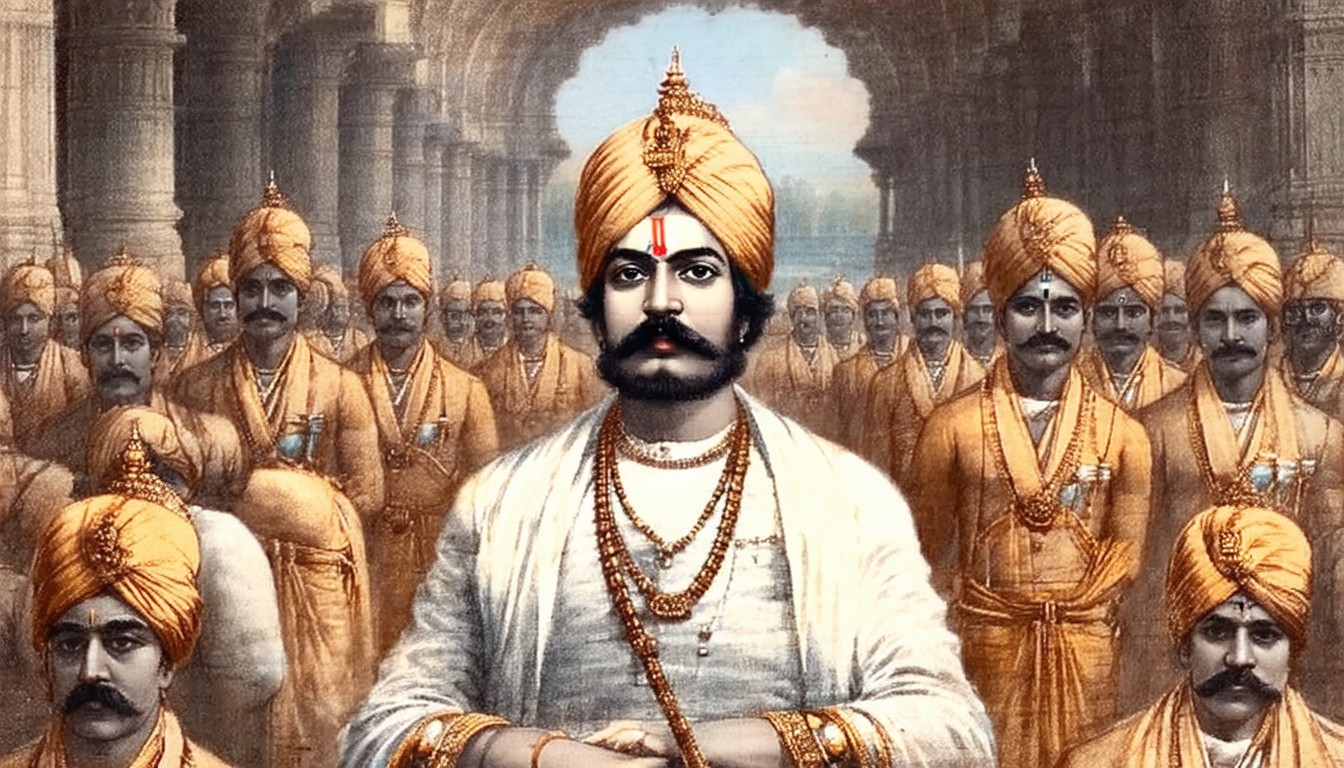
Chhatrapati Sambhaji Maharaj’s life emerged from a backdrop of political turbulence and fierce resistance. Born in 1657 at Purandar Fort, Sambhaji was the eldest son of Chhatrapati Shivaji Maharaj, the founder of the Maratha Empire, and Queen Saibai. From an early age, Sambhaji was groomed for leadership—receiving rigorous training in statecraft, military affairs, and classical literature. His upbringing in an environment charged with the struggles of establishing an independent Maratha state left a lasting imprint, equipping him to face the overwhelming challenges that lay ahead.
Within the royal household, Sambhaji mastered Sanskrit, Persian, and several regional languages, earning respect even among adversaries for his intellect and literary achievements. Despite personal hardships, including the early death of his mother, Sambhaji’s formative years built a foundation for his rule, marked by both strategic acumen and deep cultural awareness.
Rise to Power: Challenges and Consolidation
The transition of power from Shivaji to Sambhaji was neither smooth nor uncontested. Following Shivaji’s death in 1680, the newly crowned Sambhaji inherited a vast empire encircled by hostile Mughals, regional sultanates, and internal conspiracies. Powerful groups, at times including his own relatives, contested his position, resulting in a brief period of imprisonment and political intrigue.
Despite this, Sambhaji solidified control within a year through a combination of diplomacy, force, and the loyalty of key military commanders. His swift consolidation ensured the Maratha Empire could confront the imminent Mughal onslaught led by Emperor Aurangzeb. Sambhaji’s reign, though shorter than his father’s, was defined by uncompromising leadership during the empire’s most trying hour.
“Sambhaji Maharaj’s ability to hold the Maratha state together in the face of overwhelming odds remains a remarkable testament to his leadership and vision,” observes historian Dr. Uday Kulkarni. “His resistance gave the Maratha nation time to regroup and ultimately outlast Mughal aggression.”
Warrior Monarch: Military Campaigns and Defense
Resistance Against Mughal Expansion
Under Sambhaji’s direct command, the Maratha forces launched both defensive and offensive operations against the Mughal military, recognized as the largest in the world at that time. The Mughal Emperor Aurangzeb devoted a major share of imperial resources to subdue the Marathas—a campaign that would last nearly three decades and define the empire’s decline.
Sambhaji’s methods combined conventional warfare with guerrilla strategy, maximizing the advantages of the rugged Deccan terrain. Notable campaigns included the bold recapture of strategic forts such as Panhala and the defense of Raigad, as well as surprise raids deep into Mughal territory. His determination frustrated the Mughal command and inspired a generation of Maratha warriors.
Battles Beyond the Maratha Heartland
Sambhaji did not limit his vision to defending inherited territories. His campaigns extended deep into the Konkan coast and southwards against the Portuguese in Goa, reaffirming Maratha control over vital trading routes and exposing vulnerabilities in European colonial outposts of the era.
In practical terms, Sambhaji’s defense policies delayed Mughal ambitions in the south, exhausting imperial resources and contributing to a wider Deccan resistance. Many historians consider this drawn-out conflict crucial to the eventual disintegration of Mughal authority across the subcontinent.
Patron of Letters: Cultural and Intellectual Legacy
Writings and Literary Contributions
While Sambhaji is known first and foremost as a warrior king, his contributions to literature and scholarship remain an essential facet of his legacy. Fluent in multiple languages, Sambhaji authored several works, including the Sanskrit text “Budhbhushanam”. Through his writings, Sambhaji articulated the responsibilities of kingship and the philosophy of Hindu polity. His court continued the tradition of patronage that began under Shivaji, attracting poets, scholars, and artists.
His era saw the synthesis of martial valour and intellectual pursuit, making the Maratha court a center for cultural interaction. This blend of military and cultural leadership distinguished Sambhaji among the 17th-century rulers of India.
Religious Tolerance and Policy
Sambhaji’s reign, though embroiled in continuous warfare, also demonstrated a pragmatic approach to diverse faiths and communities. Despite religious tensions inflamed by Mughal orthodoxy, Sambhaji often extended patronage and protection to non-Hindu communities within his domain, including local Christians and Muslims. This aspect of his governance is often overshadowed by tales of war, but it remains a significant factor in the relative stability of the Maratha heartland under his rule.
Martyrdom and Enduring Impact
Sambhaji Maharaj’s capture and execution by the Mughals in 1689 marked one of the darkest chapters in Maratha history. Arrested after being betrayed, Sambhaji reportedly refused to convert or capitulate, enduring severe torture as a symbol of resistance. His martyrdom became a rallying point for the Maratha nation, sparking a resurgence of anti-Mughal sentiment and inspiring future generations, including figures like Chhatrapati Rajaram and the legendary Maratha general Santaji Ghorpade.
The sustained resistance following Sambhaji’s death ultimately drained the Mughal treasury, hastened Aurangzeb’s demise, and facilitated the Marathas’ eventual dominance in large parts of India by the early 18th century.
Modern Relevance: Legacy of Chhatrapati Sambhaji Maharaj
Today, Chhatrapati Sambhaji Maharaj is revered as a symbol of unwavering patriotism and sacrifice. Numerous monuments, annual events, and public memorials across Maharashtra and India underscore his enduring appeal. His birthday anniversary and martyrdom are observed with great reverence, fueling contemporary discussions on national identity, resistance, and secular leadership.
Scholars, politicians, and social reformers frequently invoke Sambhaji’s legacy in conversations around justice, social harmony, and perseverance in the face of adversity. His life stands as an inspiring example not only to the Marathi-speaking populace but to all who value the principles of self-rule and cultural pride.
Conclusion
Chhatrapati Sambhaji Maharaj’s life represents a unique convergence of valor, intellect, and steadfastness. Confronted with relentless external and internal pressures, he preserved the legacy of Chhatrapati Shivaji, ensured the survival of the Maratha state, and set the stage for future Indian resistance. His martyrdom amplified the spirit of defiance against tyranny, making his story vital to understanding both Maratha history and the broader narrative of freedom in India.
FAQs
What were Chhatrapati Sambhaji Maharaj’s major achievements?
Sambhaji defended the Maratha Empire against Mughal invasions, expanded its influence through strategic campaigns, and contributed to literature with works like “Budhbhushanam.” His resistance was crucial to the survival of the Maratha state during a volatile era.
How did Sambhaji Maharaj contribute to literature and culture?
He was a scholar fluent in Sanskrit and other languages, authoring texts that explored governance and philosophy. His court fostered a lively cultural and literary environment, continuing the traditions set by his father.
Why is Sambhaji Maharaj considered a martyr?
After his capture by the Mughals, Sambhaji refused to compromise his principles or faith, enduring severe torture and execution. His steadfastness turned him into a symbol of resistance and inspired generations after him.
How did Sambhaji Maharaj influence future Maratha leaders?
His leadership during crisis and patriotic sacrifice became guiding examples for future Maratha rulers and generals, empowering the region’s resistance against both Mughal rule and, eventually, colonial powers.
What is Sambhaji Maharaj’s significance in modern India?
He is honored as a hero of national unity and resilience. Commemorations, educational initiatives, and cultural programs dedicated to Sambhaji Maharaj help reinforce values of courage, justice, and pluralism in contemporary society.














Leave a comment